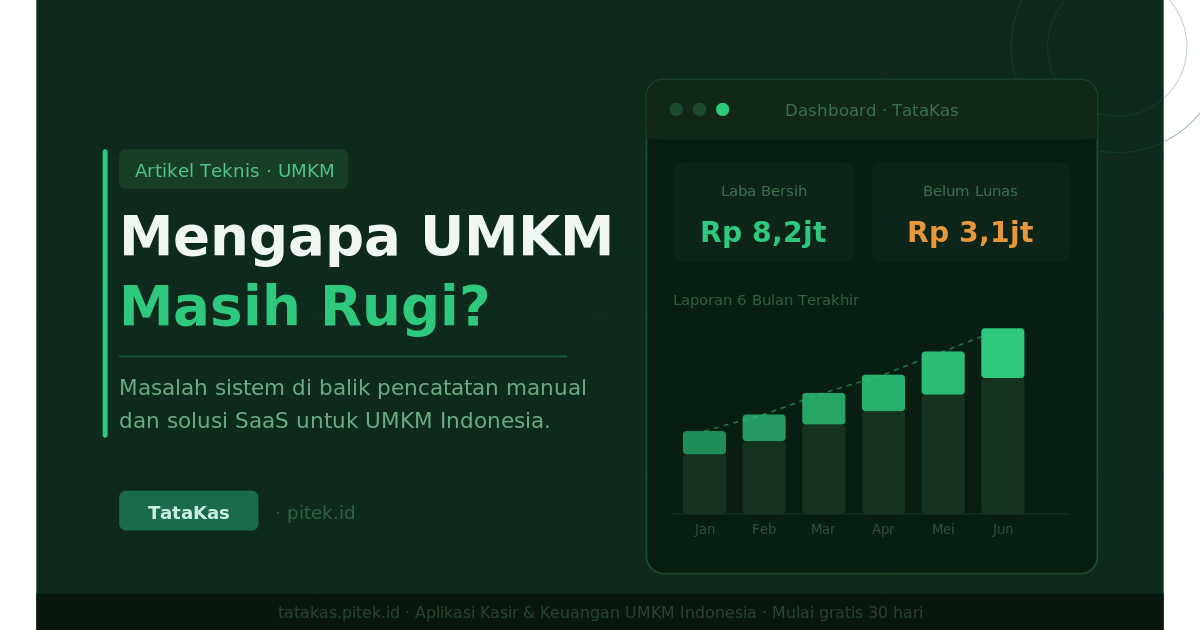
The Reality Nobody Talks About
If you've ever spoken directly with owners of small shops, food stalls, or local service businesses, you'll find an almost universal pattern: they know their business is running, but they have no clear picture of whether it's actually profitable.
It's not a matter of intelligence. It's a matter of tooling.
The tools most small businesses rely on today — handwritten ledgers, paper receipts, WhatsApp voice notes, and a half-updated Excel file — were never designed for operational scale. This isn't a behavior problem. It's a systems architecture problem.
Three Critical Failure Points in SMB Operations
1. Fragmented Financial Data
Revenue entries live in a phone's notes app. Expenses are in a pile of paper receipts. Outstanding payables exist only in the owner's memory. There is no single source of truth for the actual financial state of the business.
The consequence: business decisions are made based on assumptions, not data. And when assumptions drift from reality, margins erode quietly — often discovered only at month-end, when it's too late to course-correct.
2. Invoice Workflow as a Manual Bottleneck
Even relatively organized SMB owners still manually create invoices in Word or Excel, then send them via WhatsApp. Payment status — paid, partially paid, or overdue — exists only in memory or scattered notes.
This is a workflow that does not scale. As transaction volume grows, the entire system collapses under its own weight.
3. Inventory as a Black Box
Stock-outs are discovered only when a customer places an order. Alternatively, owners are sitting on expensive over-stock because there's no visibility into demand trends. Without an accurate stock ledger and proactive alerting, inventory becomes a liability — not an asset.
In systems engineering terms, this is an observability problem. The system is running, but there's no way to monitor it in real time.
Why Spreadsheets Aren't the Answer
Spreadsheets are powerful tools. But they were not built for multi-user concurrent access, audit trails, or automated reporting pipelines.
When two people edit the same file simultaneously, data conflicts. When a user skips a field, reports become inaccurate. There's no validation layer, no referential integrity, no foreign key constraints — everything depends on human discipline.
For the technically inclined: imagine running a production application without a database, relying entirely on flat CSV files edited by hand. That's the operational reality for tens of thousands of SMBs right now.
What a Proper SaaS Architecture Actually Solves
A platform genuinely built to address these problems must be grounded in a few key principles:
Multi-tenancy with true data isolation. Each business must operate in its own data environment — not merely filtered rows in a shared table. This is non-negotiable for both security and scalability.
Granular role-based access control (RBAC). The business owner should not have the same access level as a cashier. The warehouse manager doesn't need to see P&L reports. This isn't just about security — it's about delivering a relevant, focused UX to every user type.
Event-driven state management for inventory. Rather than storing only a final stock count, every inventory event — stock in, stock out, adjustment — should be recorded, enabling full audit trails and reconciliation at any point in time.
Automated reporting pipeline. Profit & loss statements and cash flow reports should be generated automatically from transaction data — not recalculated manually at month-end by a tired business owner.
TataKas: A Real Implementation of These Principles
TataKas is a business management SaaS built specifically for Indonesian SMBs — not as a simple cash register app, but as an integrated operational platform covering the entire business loop:
- Professional invoicing with auto-numbering, payment status tracking (paid / partial / outstanding), and one-click PDF export with partial payment support.
- Real-time financial recording with income and expense categorization — daily, weekly, and monthly summaries always available without manual aggregation.
- Ledger-based inventory management with automatic low-stock notifications and full support for stock-in, stock-out, and manual adjustments.
- Auto-generated P&L and cash flow reports with visual charts and one-click export to Excel and PDF.
- Multi-user with RBAC — four role types: Owner, Cashier, Warehouse, and Accountant, each with scoped access.
- Multi-business from a single account — run multiple entities with fully isolated data environments per business.
- Automated daily backup to Google Drive with zero configuration required.
- AI layer in the Pro tier — automated financial insights, stock recommendations, customer risk scoring, and an AI-powered financial chatbot.
Pricing: Rp 149,000/month per business for the Pro tier, with a 30-day free trial — no credit card required.
The Numbers That Frame the Problem
- 65 million active SMBs in Indonesia (Ministry of Cooperatives & SMEs)
- 61% contribution to national GDP
- Fewer than 10% consistently use digital tools for financial management
This gap is more than a market opportunity. It's a structural economic bottleneck — and technology is one of the few levers capable of closing it at scale.
Closing: Tools Are Leverage
Every developer understands this intuitively: bad architecture can't be fixed by working harder. You need to refactor. You need the right system from the start.
The same principle applies to business operations. SMBs that continue managing finances manually aren't lazy — they simply haven't had access to the right infrastructure.
Platforms like TataKas exist not to change how SMB owners think, but to give them the correct operational foundation — so their business can be run on data, not on gut feeling.
Start free, no risk: tatakas.pitek.id
